

XORA Finance: An Investigation Into Withdrawal Issues
Twenty-two hours after we asked XORA in public why its users cannot withdraw, it announced a $5.5 million bitcoin treasury. The ledger shows XORA minted that "BTC" itself — one holder, no market, no bitcoin behind it. Underneath it sits the case that started this: four people describing the same failure over six weeks, and 29,899.8 XRP sitting in the treasury XORA published on its own website.
We advise readers not to deposit funds with XORA Finance. Since first publishing this article we have spoken directly with several XORA users. Every one of them was using the real xora.finance — not a cloned site — and every one describes the same sequence: small withdrawals are paid, and the moment a large withdrawal is requested the account is frozen and the user is asked for KYC and AML documentation. Some had their accounts reset or deleted outright.
We put those reports to XORA and its founder in public on 4 August. Neither replied. Twenty-two hours later XORA announced a $5.5 million bitcoin treasury — which the ledger shows is a token it minted itself, in a wallet its own treasury created, with no market, no buyer and no bitcoin behind it.
In our assessment the risk of losing money on this platform is high. Every statement here is documented below, each with its transaction hash.
XORA minted its own "bitcoin"
We begin with the most recent development, because it happened while this article was being updated and it answers the question the rest of the piece spends its length circling: what is actually behind this platform. The sequence in which it appeared matters as much as the thing itself.
On 4 August at 01:08 UTC we put the users' reports to XORA and its founder in public, replying to both accounts: "Here some of the users claiming withdraw issues on Xora Finance all using the correct domain", with three of them linked. Neither account replied. @joren has not posted publicly since 3 August. @xora_finance went on posting through the day — two hiring adverts, a Ripple news link — and then, twenty-two hours after we asked, did this instead.
The treasury wallet itself still holds no tokens — it has zero trustlines, which as we show later means it cannot hold one, and it has never traded, lent or provided liquidity in its life. What it did instead was create the machinery next door. On 24 July, two seconds apart, it funded two brand-new wallets with 2 XRP each. One of them, rcj4KrKzMTMX1JcQ2a7KsrEeEQKYSn3Rz, issues a token whose currency code is BTC. The other, rsaBZHZWHqW9TSrCkAqfHKH5FEgKPiHKfe, holds it. Nobody else does. On the XRP Ledger anyone may issue a token and call it anything; "minting" here is typing a number into a payment. No bitcoin is involved at any point, and none was bought.
| Time (UTC) | What happened | Amount | Transaction hash |
|---|---|---|---|
| 2026-07-24 09:46 | The treasury activates the holder wallet with 2 XRP | 2 XRP | 6844407183F9C2E29E… |
| 2026-07-24 09:46 | The holder trusts the issuer for a limit of 21,000,000 BTC — bitcoin’s supply cap | trustline | 04F240F3BEEE09CB2C… |
| 2026-07-24 09:46 | A 0.000002 XRP ping from the same wallet that pinged the 16-minute burner | 0.000002 XRP | 8206D4CEE34AE32E63… |
| 2026-07-24 09:47 | First mint — a test, as with the deposits | 0.0005 BTC | CEE5814A2A3734FC1C… |
| 2026-07-25 00:15 | Second mint | 7.80210674 BTC | 74A275DBF879BCB4F0… |
| 2026-08-04 23:08 | Third mint — the day after this article first publishedNEW | 77.896 BTC | 8DCB25F9978BEB0426… |
Three payments, totalling 85.69860674 "BTC". Note the trustline limit: the holder set it to 21,000,000, the supply cap of real bitcoin. Note also the 0.000002 XRP ping that follows — it comes from rhVGXf3KKNa2nox1544s4sVrDw3NSfwwUB, the same wallet that pinged the 16-minute burner wallet described below, right after the treasury created that one. The same hand sets up both.
XORA announced it as a $5.5 million treasury, six minutes later
XORA said itself what these wallets are for. Six minutes after the mint confirmed on-chain, @xora_finance posted this:
"🚨 XORA TREASURY — 🖨️ BTC Mint Executed — Minted ₿ 77.896 BTC ≈ $5.0M — 💰 Total Treasury ₿ 85.6986 BTC ≈ $5.5M"
The post links the holder wallet on livenet.xrpl.org as its proof, and the total it advertises — 85.6986 — matches the holder's balance on the ledger to four decimal places. So there is no ambiguity about which asset XORA means. It is this one: the token minted by a wallet XORA's own treasury created, held by one other wallet the same treasury created, and by nothing else on the ledger.
That is the claim in plain terms. A platform that has not paid a single large customer withdrawal in its entire history announced a $5.5 million bitcoin treasury, twenty-two hours after being asked in public why its users cannot withdraw — and produced it by typing a number into a wallet it owns.
It is not bitcoin, and there is no market for it
Anyone can issue a token called BTC on the XRP Ledger. A currency code is three characters of text; it carries no claim on anything. What distinguishes a real bitcoin IOU is the issuer behind it and the market that prices it. Here is how this one compares to the two genuine bitcoin gateways on the XRPL:
On the validated ledger there is no AMM pool holding this token, and no order book — zero offers to buy it and zero to sell it. It has never traded. Nobody can convert it into XRP, into bitcoin, or into anything else, at any price, because there is no counterparty in existence.
It also cannot spread. The issuing wallet has the lsfRequireAuth flag set, which on the XRP Ledger means no account may hold the token without the issuer's explicit authorisation. This asset was built so that only wallets its creator approves can ever hold it. Today that is exactly one wallet, and the creator funded that wallet too.
What $5.5 million of it could actually be sold for
Nothing. Not a reduced amount, not at a discount — there is no price at which any of it can be converted into anything, because there is no counterparty permitted to exist. The $5.5M figure is arrived at by taking a number XORA typed into its own wallet and multiplying it by the price of an unrelated asset that it does not hold.
This is the difference between a reserve and a label. A real reserve can be sold to meet withdrawals; that is the only property that makes it a reserve. Measured against the promise on XORA's own yield page — that returns come from "a finite, disclosed treasury reserve, not from new depositor inflows" — the ledger says the disclosed reserve is 99.35% customer deposits, and the newly announced $5.5M cannot be spent by anyone.
Anything reading balances by currency code will nonetheless display that wallet as holding 85.7 BTC. A portfolio view, a screenshot, an explorer page linked as proof, a depositor checking whether the platform is solvent before sending more: each shows bitcoin that does not exist. XORA linked exactly such an explorer page as its evidence.
Both wallets are now on the XRPL.to scam-address list, which any wallet or marketplace can read from our public scam API before a user signs a transaction.
The pattern, in one place
Before the detail, here is the whole case in the order a depositor would meet it. Each point is documented further down, with hashes.
Any one of these has an innocent explanation available. Together, and in a platform holding other people's money, they describe something that has a name in this industry, and the last item is the one that usually arrives at the end.
How this started: the two explanations
The rest of this article is the investigation that led us to ask XORA the question it answered with a mint. It runs in order: the dispute that started it, whether the money arrived, what the treasury does with it, and who is behind the platform.
On 3 August 2026 a depositor posting as @gimgyeongh62101 published a timeline of his attempt to withdraw 29,899.8 XRP from XORA (xora.finance, @xora_finance), together with screenshots of both conversations. He is careful in it: "I am not making accusations. I am simply asking XORA to clarify the apparent inconsistency." The inconsistency is that he was given two explanations that flatly contradict each other — an account frozen under review, and an account that never existed. As it turns out there is a way both could be uttered honestly, and it is worse than either.
What XORA support told him
The first came by direct message from the verified @xora_finance account on 26 July. Its wording is unusually specific:
"Hi, this is XORA support (@xora_finance). We saw your public posts about a stuck withdrawal. We matched your X account to XORA email [his Gmail address] (tag 287588244). Your account is currently under a manual AML hold (withdraw freeze + lifetime cap 0). We are NOT releasing funds automatically from this chat. Please reply here with: (1) confirm that email is yours, (2) your Telegram username, (3) the exact amount and destination you tried. We will continue the review from there."
A follow-up message adds: "We emailed [his address] about your account." So XORA's own support channel knew his email, knew tag 287588244, called it "your account" twice, and described a specific internal state applied to it — a manual AML hold with a withdrawal freeze and a lifetime cap of zero. A lifetime cap of zero means no amount can ever be withdrawn.
What the founder said
The second came later, relayed through a third party who messaged founder Joren Lundgren directly. We did not receive it from him and cannot independently authenticate it: what follows is transcribed from a screenshot the depositor published, of a conversation he was not party to. He paraphrases the same four points in his own words in his post. With that caveat, the screenshot shows four consecutive messages:
"Hey we looked into it, he fell for a phishing website" · "He was one of those Koreans who fell victim, that police case that got posted about recently" · "He never had an account with us" · "There was a fake Xora website as well"
The same conversation then asks him to supply "the XRPL tx id of where you sent the 29k XRP". Around the same time, XORA and its founder published public warnings about "a group of South Korean scammers" targeting the XRP community and fake sites cloning XRP brands.
Phishing against XRP holders is real, and warning people about it is legitimate. But an account that is frozen under an AML hold and an account that never existed are not the same account, and the second explanation makes a specific, checkable claim about where the money physically went. That part does not depend on anyone's word: the ledger records where the money went.
Screenshots can be edited, so we treat them as claims rather than proof — with one exception noted in the next section: the exchange receipt he published contains a transaction hash that matches the validated XRP Ledger exactly, which is not something a screenshot can fake.
What happened next, on the same day
All three of these posts are public, and X records the minute each went out. Read together they are the whole dispute in under two hours:
Less than two hours after the depositor published his evidence, XORA posted a phishing alert; its founder posted his own a minute later. Neither mentions the dispute, and neither replies to him — as of 2026-08-03 the thread has replies from other users but none from @xora_finance or @joren.
The framing is worth stating plainly, because it is unusual. The depositor is a Korean XRP holder saying he was harmed. The founder's post describes "a group of South Korean scammers" as the people to be careful of. We are not claiming the posts were written about him — they name nobody, and the police investigation XORA cites is a real and separate matter. But the sequence is a matter of public record, and a warning that casts a nationality as the perpetrator, published two hours after a member of that nationality published evidence against you, is worth noting.
He returned the next day, 4 August at 11:36 UTC, with a consolidated thread setting out the whole sequence in one place. Its opening is the same register he has used throughout:
"XORA Finance – My XRP Withdrawal Timeline. Over the past several weeks, I have been trying to understand what happened to my XRP. This thread is a factual summary of my experience. I am not accusing anyone of wrongdoing. I am simply asking XORA to clarify several technical inconsistencies."
That thread has been seen 3,857 times as of 2026-08-05. It is still unanswered by XORA or its founder. Twelve hours after he posted it, the treasury minted 77.896 "BTC".
The deposits exist, and they went to XORA's own treasury
Two validated payments carry destination tag 287588244. Both were sent to rhbErkS2d4H82tRbdGyFkhhc4LNtjKaC3o, both succeeded (tesSUCCESS), and both came from hot wallets of major exchanges (labels are public and explorer-verified):
| Payment | Time | Amount | Sender | Transaction hash |
|---|---|---|---|---|
| Test deposit | 2026-07-13 08:25:00 UTC | 8.71554 XRP | Bybit hot wallet rMvCasZ9cohYrSZRNYPTZfoaaSUQMfgQ8G | 55EFF2C56321FA25F2B3… |
| Main deposit | 2026-07-13 09:02:02 UTC | 29,899.80 XRP | Binance hot wallet rBtttd61FExHC68vsZ8dqmS3DfjFEceA1A | 4FD202B3DB7ADCA94ABD… |
The pattern is a careful retail depositor, not a victim mid-phish: an 8.7 XRP test payment first, then the full amount 37 minutes later — from two different exchanges (Bybit, then Binance), both re-using the same destination tag. The main payment settled in ledger 105,566,760 on 2026-07-13 at 09:02:02 UTC and moved the destination wallet from 95,648.31 to 125,548.11 XRP — at that moment the disputed deposit was roughly a quarter of everything the wallet held.
The exchange receipt matches the ledger exactly
Among the screenshots he published is his own Binance withdrawal receipt. This one is worth more than the message screenshots, because it can be checked against something no screenshot controls. It reads: −29,899.8 XRP, Completed; destination address rhbErkS2d4H82tRbdGyFkhh…NtjKaC3o; memo beginning 2875; and a transaction ID of 4FD202B3DB7ADCA94ABDF3C…, dated 2026-07-13 18:01:49 in his local time.
Every one of those matches the validated ledger: the same hash, the same treasury address, the same amount to the drop, and the same moment (18:01:49 in Korea is 09:01:49 UTC; the ledger closed it at 09:02:02). A forged receipt would have to coincide with a real, validated payment of exactly that size to exactly that wallet at exactly that second. So the deposit itself is established beyond the screenshots: this money left his own KYC-verified Binance account and arrived in XORA's treasury.
XORA published that exact wallet as its treasury
The destination is not an attacker's address. It is the wallet XORA itself published. XORA's own about page — archived at web.archive.org on 2026-06-03, five weeks before the deposit — reads:
"All user XRP is pooled in a single shared treasury wallet on the XRP Ledger. Each user deposit is routed via a unique destination tag that maps it to that user's account. Treasury balance and inflows are publicly verifiable on-chain: rhbErkS2d4H82tRbdGyFkhhc4LNtjKaC3o"
The same page answers "Where can the XORA treasury be verified?" with the same address, "viewable on XRP Ledger explorers such as livenet.xrpl.org or xrpscan.com." XRPScan carries a verified label for the wallet: "Xora Finance", domain xora.finance, X handle @xora_finance. XORA's site also published step-by-step guides for exactly the flow this depositor used — "Deposit XRP from Binance to XORA" (a Bybit version too), instructing users to withdraw from the exchange with "the destination tag shown in your account."
The wallet's behaviour matches that description. Since its activation on 2026-03-08 it has received 2,269 successful inbound payments across 1,723 distinct destination tags — a custodial deposit wallet running a per-user tag scheme, exactly as the about page said. Tag 287588244 is one of those tags, and it received exactly two payments: the test and the 29,899.8 XRP.
What a destination tag does not give you
This is the part worth being blunt about, because the tag scheme reads like an account number and is not one. A destination tag is a number attached to a payment. It confers no ownership, no claim and no rights on the XRP Ledger. Once the payment settles, the XRP belongs to the treasury account and to nobody else; the tag survives only as a row in XORA's own private database, mapping a deposit to a user in software XORA controls and we cannot see. If that record is edited, reset or deleted — and users have told us their accounts were reset or deleted — the chain neither knows nor cares. The XRP does not move back.
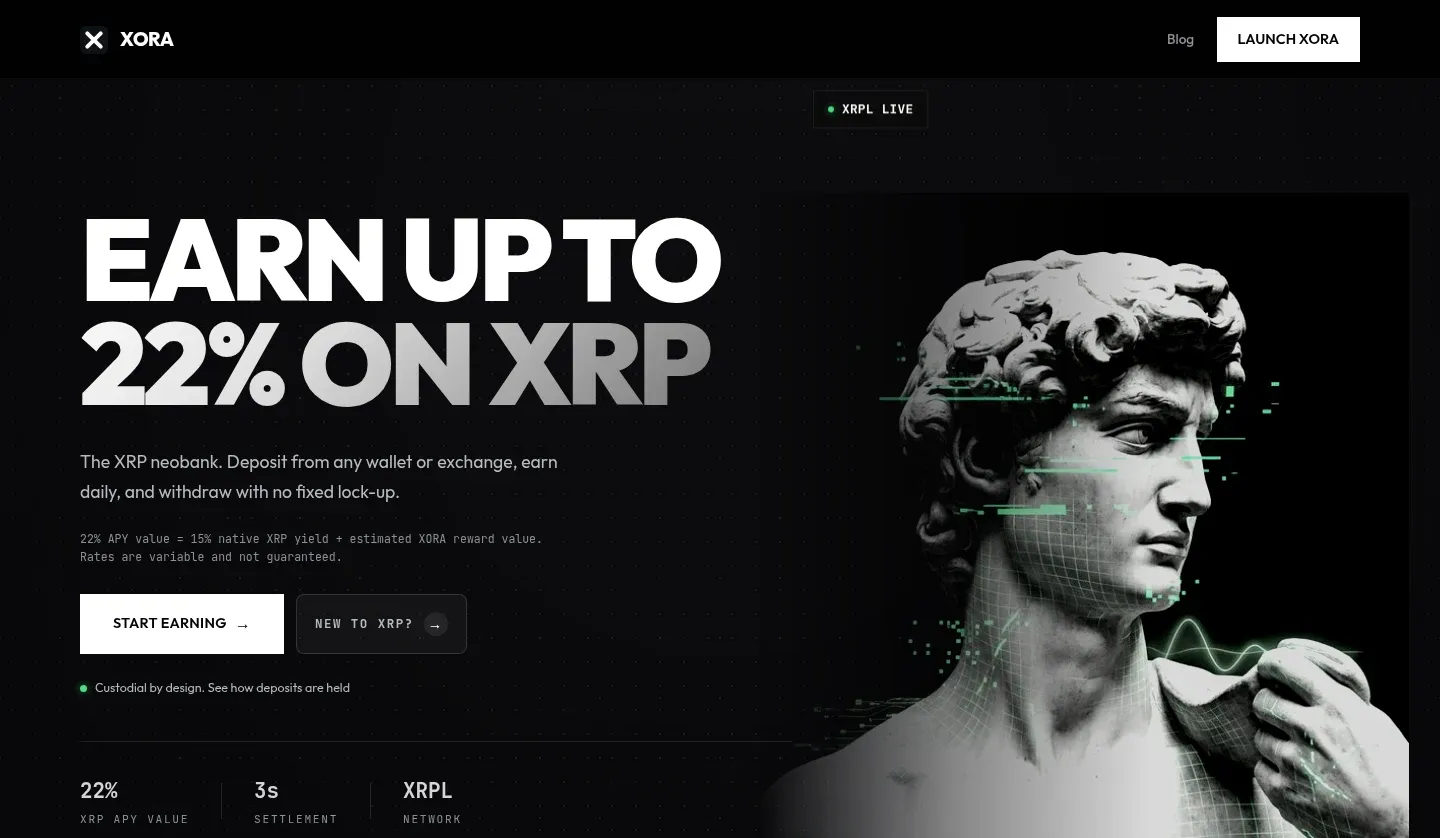
That makes XORA fully custodial, which it does not dispute — it advertises it. In small green type under the "Start earning" button on its landing page, reproduced at the top of this article, are the words "Custodial by design", and its about page says user XRP is "pooled in a single shared treasury wallet". The disclosure is honest as far as it goes; the question is what stands behind it. What the ledger adds is how little stands between that pool and one person. On 2026-08-05 the treasury account holds 211,278 XRP with no signer list, no regular key, no escrow and no account flags set whatsoever — the master key is live and unrestricted. There is no multisig, no timelock, and no withdrawal limit enforced by anything other than XORA's good intentions. The 3-of-5 multisig its security page describes remains, in its own words, "on the roadmap".
A depositor is therefore not holding XRP with a service. They have given it away and received a database entry, backed by an unnamed individual with no company, no regulator and no auditor behind them. Every other finding in this article is downstream of that arrangement.
What the phishing explanation does not account for
A ledger records payments, not sign-ups. It cannot show who opened an account, so on its own it cannot prove or disprove that this depositor registered one. What it can do is test the phishing explanation against what actually happened on-chain, and that explanation has to answer all of the following.
- Phishing of this kind normally steals by substituting the attacker's address. That is exactly what the South Korean case XORA points to did: in the Fxrpntwork.com fake-Flare operation, victims sent their XRP to wallets the fraudsters controlled. Here the opposite happened — the funds went to the treasury wallet XORA published on its own website, so the XRP ended up in XORA's custody with no third-party phisher on the receiving end of either transaction.
- The tag behaves like a real account. XORA's own materials say each destination tag maps to one user's account. Tag 287588244 was used twice, 37 minutes apart, from two different KYC exchanges — and by the depositor's account, XORA support matched that same tag and his email to "his account" and placed it under an AML hold. The support version of events is the one consistent with the chain.
- The money is fully traceable on both ends. The deposit came from Binance and Bybit hot wallets — withdrawals from the depositor's own exchange accounts, where his identity is KYC-verified.
- No refund is visible. As of 2026-08-03 there is no outgoing payment from the treasury that returns the deposit or anything near it to the depositor.
There is one scenario that would reconcile the founder's statement with the ledger, and we should state it plainly rather than leave it out: a criminal opens a genuine XORA account with their own wallet, attaches the victim's email address to it, and points the victim at it through a fake front-end. The tag would then be real and XORA-issued, the emails the victim received would be real, and the victim would still never have registered anything. The ledger cannot exclude that, because none of it happens on the ledger.
It is not, however, a free explanation. It requires that XORA's sign-up allows one account to carry another person's email address; it predicts that XORA's own withdrawal-confirmation emails for the cash-outs of 14 and 16 July would have reached the depositor, who instead spent the following week asking where his withdrawal was; and it does not explain a "manual AML hold (withdraw freeze + lifetime cap 0)" described in the present tense on 26 July, ten days after the balance would already have gone. XORA can settle all of it in one step, and we asked: publish the wallet that registered the account behind tag 287588244 and the date the email was attached to it. Both are checkable against the chain in minutes.
XORA's own anti-scam notice cuts against the phishing story
XORA's security page tells users exactly where a deposit tag comes from:
"Your only deposit address and destination tag are inside the signed-in dashboard at xora.finance/app. The tag is unique to your account; without it an XRP deposit cannot be credited automatically. Prefer a small test send (1–5 XRP) before moving a larger balance."
Read that against what the ledger records. The depositor sent a small test payment first, then the full balance — the exact procedure XORA recommends. He used a tag that is unique to an account, from a space only the signed-in dashboard hands out. By XORA's own description, a destination tag is not something a phishing site can conjure: it has to come from a real XORA account, or the deposit could not be credited to anyone.
So tag 287588244 came out of XORA's own tag space, issued to some account through the signed-in dashboard. Whose account that is remains the whole question — but a phishing site cannot mint one, which is why the only surviving version of the phishing story is the one set out above, where the account is real and belongs to someone else.
The $20m Korean case is a different case
Put to us directly, XORA's founder described a ring of roughly thirty victims, about $20m stolen, South Korean police involvement, and an entry point of a QR code scanned physically in Korea. Those figures were given to this publication in a message, not published anywhere, so we quote them as his account rather than as established fact. There is a documented South Korean case matching most of them, and it is not XORA's.
In October 2025 a fake site impersonated Flare Network and its FXRP staking product — named by Decrypt as Fxrpntwork.com, which also reports that investors were "directed to move XRP off domestic exchanges, through overseas venues, and into wallets the group controlled". Seoul police report 3.4 million XRP taken from 71 investors — about $8.5m, with up to $19m the scammers may have taken in total — promoted through blog posts, articles and YouTube videos. CoinDesk reports two people detained on aggravated fraud charges with an Interpol Red Notice sought for a third who had left the country; Decrypt puts the arrests at three with a fourth abroad. The outlets differ on the count; they agree on the mechanism.
Three details stop that case from explaining this one. It had 71 victims, not thirty. It was seeded through blogs and video, not a physical QR code. And its victims sent XRP to wallets the fraudsters controlled — the ordinary phishing pattern, and the opposite of what happened here, where the money went to XORA's own published treasury. XORA's own alert of 3 August describes the police matter as one the authorities probe "separately".
That distinction matters because the founder did not gesture vaguely at Korean fraud. He identified this depositor with that specific case: "He was one of those Koreans who fell victim, that police case that got posted about recently." The reporting he refers to went out on 30 July 2026, four days before the depositor published. And the defining fact of that case is that its victims paid wallets the fraudsters controlled — while this depositor's 29,899.8 XRP went to the treasury address XORA published on its own website, under a tag from XORA's own tag space, where it can still be seen. Both cannot describe the same money. The claim that he is one of those victims does not fit the payments it is offered to explain.
The separate assertion appended to it — "There was a fake Xora website as well" — remains unsubstantiated: none has turned up. There is a fraudulent site trading on the name, covered further down, but it is a counterfeit bank with no XRP anywhere in it, and it could not have produced the deposit tag this dispute turns on.
The tag his account now shows has never received a payment
The same thread records something checkable. After the failures, the deposit tag his account displayed changed — same wallet address, one digit different: 287588244 → 287588246 — and roughly 29,000 XRP, along with the transaction history, vanished from the account while he was using the same login.
The treasury has received 3,283 payments in its whole history to 2026-08-03. Tag 287588244 received exactly two, on 13 July — the 8.71554 test and the 29,899.8 main deposit. Tag 287588246 has never received a single payment, from anyone, ever.
That is the shape of the contradiction. On 26 July support looked him up, found tag 287588244 with a balance, and described a live withdraw freeze on "your account". Whatever his login resolves to now points at a tag with no deposits behind it — which is exactly what a system would report as a person who never had an account. Both statements can be produced by one broken mapping, and neither requires a phishing victim.
The explanation changed four times
By the depositor's own account, he was given, in order: an RPC issue, then a compromised local hosts file, then a fake website, then that he had never had an account at all. A third party who examined his machine reported publicly on X (post since deleted, no archive snapshot exists) that the hosts file was the untouched Microsoft default with no XORA entries and a modification date years earlier, that the site served valid HTTPS with no certificate warning, and — the part a local compromise cannot survive — that the same fault reproduced on a different device over a cellular connection. The deposit address he was shown never changed either; only the destination tag differed.
A name-squatting scam site exists — but it is not the fake XORA
XORA's founder said a fake XORA website existed, and nobody has ever named one. There is a fraudulent site trading on the name — xorafinance.com, against the real xora.finance — and it deserves a warning of its own. But it is not a clone of XORA, and it cannot be the site in this dispute. We are stating that plainly because we initially thought otherwise.
Across its homepage, sign-in and registration pages, xorafinance.com contains no occurrence of "XRP", "XRPL", "Ripple", "crypto", "wallet", "token", "blockchain", "deposit", "yield", "staking" or "APY". It carries no XRP address and no destination-tag field anywhere. It therefore could not have issued the per-user tag at the centre of this dispute, shown anyone an XRP balance, or produced a withdrawal screen. Its design is a pale corporate-bank template, not XORA's dark crypto interface.
What it actually impersonates is a bank. It claims "$3T+ Assets Managed" and "200k+ Employees", uses Bank of America's exact brand navy and its corporate purpose statement verbatim, and a careless find-and-replace has left the string "BIN" spliced through real words — "CapaBINlities", "visiBINlity", "SustainaBINlity". Its registration flow is gated behind email verification and then asks for a government ID or passport and a proof of address, both required, plus source of funds and expected monthly transaction volume. A live-chat widget offers "support". Anyone who completed that flow has handed identity documents to a stranger, which is a worse loss than money, and it is the reason we are naming the domain at all.
One correction we owe the record. The depositor wrote that from 24 July he emailed support@xorafnance.com alongside the genuine hello@xora.finance. That first domain — spelled without the second "i" — is not registered at all: no address record, no mail server, and a registry lookup returns no match. Mail to it cannot be delivered and cannot be answered. By his own account the emails went unanswered — "there was no reply" — and the response came only after he posted publicly, in the direct message quoted at the top of this article, which asks him to confirm his email, supply a Telegram handle, and state the amount and destination. So the document request he describes arrived through that channel, not from the website. We had earlier connected it to the scam site's harvesting flow; that connection was wrong.
Where did the 29,899.8 XRP go?
Into the pool. XORA's stated design is that all user XRP is commingled in this one wallet, so the specific coins cannot be singled out once deposited. What the ledger does show is the pool's behaviour after the deposit landed: in the three weeks that followed, roughly 133,800 XRP left the treasury in payments of 1,000 XRP or more. The largest and most repeated destinations are instant-swap services — ChangeNOW received 42,600 XRP across three payments (the first of them 18 hours after the deposit), FixedFloat 15,000 XRP — plus 14,000 XRP each to two tagged exchange-style deposit wallets.
Despite the outflows, deposits kept arriving, and as of 2026-08-03 the treasury holds about 214,185 XRP — roughly seven times the disputed deposit. The funds to make this depositor whole are sitting in the wallet today.
He is not the only one, and it started a month earlier
The dispute reads like one depositor's bad luck until you look for others. Four separate people, across six weeks, describe the same failure in the same words: the withdrawal is accepted, the interface reports it complete, and nothing ever appears on the XRP Ledger.
| Date | Account | What they said |
|---|---|---|
| 25 Jun | @IceKomal57794 | "Now withdrawal went through but I still didn’t recieve." Nothing on XRPScan; blocked for asking. |
| 29 Jun | @ParchieSha26370 | Posted video of a withdrawal that never landed; blocked. |
| 24 Jul | @gimgyeongh62101 | 29,900 XRP. 3 of 12 withdrawals succeeded; the rest returned "Withdrawals temporarily paused." |
| 3 Aug | @MahanAbe | "I’m having the same issue of unsuccessful withdrawals of my XRP." |
The two June reports matter most, because they land a month before this dispute and before the imitation site's certificate was issued — and both users were addressing, and were blocked by, the genuine @xora_finance and its founder. A counterfeit website does not block you from the real company's account.
XORA said withdrawals were paused, nine days before the freeze
The clearest statement of the problem came from one of XORA's own paid contributors. On 15 July @_wasbak wrote, approvingly:
"another thing i appreciate is transparency. XORA has openly communicated that withdrawals are temporarily paused while treasury reconciliation is being completed. i always prefer when projects communicate challenges clearly instead of pretending everything is perfect."
That is nine days before this depositor's 24 July freeze and two weeks before he went public. The same caveat is embedded in the promotional copy from 7 July onward — withdrawals "processed after account, treasury, reconciliation, and risk checks" — while the headline sold everywhere else was instant withdrawal with no lock-up. Whatever explains one Korean depositor, it does not explain a treasury reconciliation that XORA announced to its own promoters before he ever complained.
What XORA users have told us directly
Since this article first published we have spoken with several XORA users, separately. Their accounts are consistent with each other and with what the ledger shows, and they close the one gap the chain cannot settle on its own.
Every user we spoke to was using the real xora.finance. Not a lookalike domain, not a link from a direct message — the site XORA itself advertises. That matters because the phishing explanation requires a fake site to have been involved, and these users did not go near one.
The pattern they describe is the same each time, and it is a specific one:
- Small withdrawals are paid. Modest amounts leave the platform and arrive, which is what makes the account feel functional and encourages a larger deposit.
- A large withdrawal request changes everything. At that point the account is frozen and the user is asked for KYC and AML documentation — after the deposit, not before it, and only once the sum is worth keeping.
- Some accounts were reset or deleted outright. Users described logging in to find their balance or their account history simply gone.
That sequence is visible in the treasury's own payment record: hundreds of small payments out, and not one large customer withdrawal in the wallet's entire history. The largest payment it has ever sent went to a no-KYC swap service, not to a customer.
It also settles the contradiction this article opened with. XORA's founder told a third party that the depositor "never had an account with us" — while XORA's own support account had already written to that same person quoting his email address and tag 287588244, calling it "your account", and placing it under a manual AML hold. Other users have now described the same freeze-and-document routine on accounts they certainly did have. On the evidence available to us, the founder's statement was untrue.
Who uses this wallet — and does anyone get money out?
We went through every payment this wallet has ever received and every payment it has ever sent. The picture is simple: many people have tried it with pocket change, a handful of people trusted it with serious money, and serious money has never come back out.
Most of the money comes from just a few customers
Withdrawals: many tiny ones, and the big money goes elsewhere
The wallet has sent 975 payments out, worth 243,735 XRP in total. Split those payments by size and two opposite stories appear. Count the payments, and almost all of them are tiny — that is the retail withdrawal button working. Count the XRP, and almost all of it left in a few very large payments — and every payment over 10,000 XRP went to an instant-swap service or an exchange-style wallet, none of which ever deposited as a customer.
To be fair to XORA: small withdrawals genuinely work. 80 wallets that deposited later received money back, often a little more than they put in — which looks like yield being paid, and it is exactly what builds confidence to deposit more. What has never happened, in the wallet's entire history, is a large depositor getting their money back.
In plain terms: if you deposited 100 XRP into XORA, the record says you could probably get it back. If you deposited 30,000 XRP, no one in the wallet's history ever has.
Every large payment, with its transaction hash
These are all seven payments of 10,000 XRP or more the treasury has ever sent, each with its transaction. Not one of them went to a customer wallet.
| Date (UTC) | Amount | Destination | Transaction hash |
|---|---|---|---|
| 2026-06-26 03:02 | 10,031.71 XRP | ChangeNOW (no-KYC instant swap) rKKbNYZRqwPgZYkFWvqNUFBuscEyiFyCEtag 752256979 | D25CC01F14E7AD0F15C5CD74… |
| 2026-07-14 03:13 | 14,500 XRP | ChangeNOW (no-KYC instant swap) rKKbNYZRqwPgZYkFWvqNUFBuscEyiFyCEtag 332139871 | 24CE366958EC617BFDB95744… |
| 2026-07-16 18:49 | 14,000 XRP | forwarding wallet → KuCoin hot wallets rwXnv8BfEHi7WmkLXZ6ChcWX9hMnSsTMNKtag 2097374088 | 587108CF680F40F0B02583A4… |
| 2026-07-25 15:16 | 15,000 XRP | FixedFloat (no-KYC instant swap) rffGCKC7Mk4cQ5aUGg8pfRe3MPC7Cy8gfetag 674956 | 55367175B2EAA62C0AB07269… |
| 2026-07-26 07:17 | 19,000 XRP | ChangeNOW — largest payment in the wallet’s history rKKbNYZRqwPgZYkFWvqNUFBuscEyiFyCEtag 878387516 | 9CE22500687E41726CFF7AF8… |
| 2026-07-27 23:13 | 15,000 XRP | brand-new wallet created by the treasury — deleted 16 minutes later rwp6dJeGKgUMvem9DeHP9F8ZE8pJ7dYTWq | 2746BCA508B89EBE7F398EB0… |
| 2026-07-29 18:45 | 14,000 XRP | forwarding wallet → 1.56M XRP onward to the same KuCoin route rJt8MVKSLMLtpKeA19xhEQdLTH8rmBuzghtag 220866386 | D4A39BE359680BBDE3D8A3E8… |
Three went to ChangeNOW and one to FixedFloat — no-KYC instant-swap services. A swap service converts XRP into another coin and sends it to a different blockchain: after that hop, the money cannot be followed on the XRP Ledger at all, and no identity is attached to it anywhere in the process. ChangeNOW has never deposited into the treasury; FixedFloat's only inbound payments are 2,784.95 XRP returning on 2026-05-13 and 4.59 XRP on 2026-07-31. So none of these large payments can be a customer taking their own money out.
Two more went to wallets that simply pass money along. rJt8MVK… has forwarded 1,563,093 XRP onward to rwXnv8Bf…, which in turn is high-volume exchange infrastructure that has moved 204 million XRP into KuCoin hot wallets. Both keep almost no balance — money arrives and leaves. The seventh payment is the strangest of all.
The wallet that existed for 16 minutes
On 27 July the treasury sent 15,000 XRP to a wallet that had never existed before — the treasury itself created it with that payment. Sixteen minutes later the wallet erased itself from the XRP Ledger and pushed the money onward. Here is its entire life, all three transactions:
An AccountDelete is permanent: the account is removed from the ledger and its whole balance is handed to one address. A wallet created, used once and destroyed inside seventeen minutes is a burner — the purpose of destroying it is that nothing is left to look at.
The address it swept into, rn6Cnr…, is not an ordinary wallet either. It collected 524 AccountDelete sweeps from 514 different short-lived wallets, paid the proceeds onward to swap and exchange wallets — including the same rwXnv8Bf… route to KuCoin — and then, on 29 July, deleted itself too, sweeping what was left to yet another address. This is layering: a structure whose only function is to break the chain between where money came from and where it ended up.
In fairness, single-use wallets are not automatically sinister — some services generate a fresh address per transaction and reclaim it afterwards. What is not ordinary here is that XORA's treasury created this wallet itself, funded it with customer money, and it was destroyed 16 minutes later into a hub that has done this 524 times and has since destroyed itself.
What the treasury has never done
XORA says the yield it pays will move to "XRPL AMM liquidity provision and on-chain lending markets." Those activities are not private — every one of them would leave a permanent, public record on the XRP Ledger. Every transaction this wallet has ever signed, of every type:
That is the whole list. Money in, money out, and seven pieces of incoming noise it did not ask for. Specifically, these are the counts for everything a yield business would be doing:
| Activity | Times ever | What it would have shown |
|---|---|---|
| AMM liquidity deposits | 0 | the yield source XORA names for the future |
| DEX trades or offers | 0 | any trading, market making or rebalancing |
| Lending transactions | 0 | the other named future yield source |
| Trustlines held | 0 | the wallet holds no tokens of any kind |
| Multisig signer list | 0 | custody is a single key today |
The treasury has never provided liquidity, never traded, never lent, and holds no token of any kind — it has zero trustlines, which on the XRP Ledger means it literally cannot hold one. So the advertised return, currently up to 22% APY, is not being generated by anything this wallet does. XORA says as much themselves: the yield is "currently subsidised by the XORA treasury as a temporary bootstrap mechanism." Read plainly, that means today's depositors' returns are paid out of money the treasury already holds — which is money other depositors put in.
The security page also states that a "3-of-5 XRPL multisig migration is on the roadmap and should not be treated as live custody until the signer list is published on-chain." The ledger confirms that honestly: there is no signer list. Every XRP in the wallet sits behind a single private key held by one unnamed person.
Where the money paying that yield actually comes from
XORA's yield page makes one very specific promise about this. It says the 15% is "paid from a finite, disclosed treasury reserve — not from new depositor inflows." That is a claim the ledger can test directly, because every XRP that has ever entered this wallet is recorded, and customer deposits are labelled as such by their destination tag.
There is no reserve. The largest non-customer payment this wallet has ever received is 2,785 XRP — and it came back from FixedFloat, the swap service, so it is the treasury's own money returning. The wallet was activated with 88 XRP. In its entire history there has been no capital injection: no founder funding, no investor round, no reserve transfer. 99.35% of everything in it arrived as somebody's deposit.
XORA discloses no address for the reserve it describes, and the only wallet it ever published holds nothing but deposits. So on the evidence available, yield paid out of this treasury is yield paid out of depositors' money — the exact thing the disclosure says it is not. If a separately funded reserve exists somewhere else, publishing its address would settle the question in one step.
The other 7% of the advertised 22% is not XRP at all. It is "estimated value" of the XORA reward token, and XORA states plainly that "XORA is not currently a tradable token." A token with no market has no price, cannot be sold, and the treasury does not hold one — the wallet has zero trustlines, so on the XRP Ledger it holds no tokens whatsoever. Roughly a third of the headline rate is therefore denominated in something that does not yet exist as a tradable asset.
What XORA says, and what the ledger shows
| XORA's claim | On-chain | What we can verify |
|---|---|---|
| Each deposit is routed by a per-user destination tag | confirmed | 1,723 distinct tags across 2,269 deposits — the scheme works exactly as described. |
| Withdrawals settle back to XRP Ledger wallets you control | partly | 939 payments under 1,000 XRP look like real customer withdrawals. No large one ever has. |
| Yield will come from XRPL AMM liquidity and lending | not started | Zero AMM deposits, zero trades, zero lending transactions in the wallet’s entire history. |
| Yield is currently subsidised by the treasury | consistent | Nothing on-chain earns anything, so the payouts can only come from money already held. |
| The subsidy is paid from a reserve, "not from new depositor inflows" | contradicted | 99.35% of every XRP ever received by this wallet came in as a tagged customer deposit. No reserve funding has ever arrived, and no reserve address is published. |
| 22% APY — 15% in XRP plus 7% in XORA token value | partly | XORA states the token "is not currently a tradable token"; the treasury holds zero tokens. About a third of the headline rate has no market price. |
| Treasury balance and inflows are publicly verifiable | confirmed | The address is published on xora.finance/xrpl-custody and /guides/is-xora-safe, and every figure in this article was read from it. |
| Custody protected by controls and circuit breakers | single key | No multisig signer list exists — XORA discloses this too. |
XORA publishes this address itself
In the version of XORA's about page archived on 3 June 2026, the question "Where can the XORA treasury be verified?" was answered with the address itself: "The active treasury wallet address is rhbErkS2d4H82tRbdGyFkhhc4LNtjKaC3o, viewable on XRP Ledger explorers such as livenet.xrpl.org or xrpscan.com."
It has since moved off the about and security pages, but on 2026-08-03 it was still published: the address appears twice on xora.finance/xrpl-custody and nine times on xora.finance/guides/is-xora-safe, in prose and in the pages' structured data — "The active treasury wallet address is rhbErkS2d4H82tRbdGyFkhhc4LNtjKaC3o. View it on any XRPL explorer." So the wallet examined throughout this article is the one XORA nominates for exactly this purpose, and every figure here can be checked against the source XORA points to.
Who is behind XORA?
For a custodial platform, this matters as much as the ledger: if the money stops coming back, who is accountable? We searched for the public record behind XORA and its founder. This is everything we could verify, and everything we could not.
- An X account, @joren, describing Joren Lundgren as founder and CEO, an XRP holder since 2016.
- That account's own public "About this account" panel, which anyone can open on X.
- A paid press-release wire from 1 July 2026 announcing the launch, syndicated to finance sites. Wire distribution involves no verification of its claims.
- The domain xora.finance, registered 16 February 2026 — under six months old.
- The treasury wallet, activated 8 March 2026.
- Any company registration tying XORA to the claimed Stockholm base — nothing in Swedish company records.
- Any financial licence or regulator registration in any jurisdiction. XORA confirms it is "not a chartered bank" and names no regulator.
- A LinkedIn profile, employment history, prior company, interview or photograph for the founder.
- A single named team member. The site says only "founder-led by a small remote-first team" — no names appear anywhere on it, and none in the whitepaper either.
- Any auditor, custodian or reserve attestation.
X now shows an "About this account" panel on every profile, and @joren's is worth opening. The account was created in March 2014, which makes it look long-established — but the same panel records a username change in December 2025. The handle has carried this identity for about eight months, not twelve years, and that change lands two months before xora.finance was registered. Its blue check dates from March 2026, the same month the treasury was activated. The panel also gives the account's location as North America, while XORA's press material places the company and its founder in Stockholm, Sweden.
The whitepaper deserves a moment on its own. It allocates 15% of the token supply — 150 million tokens — to "Team & Development" on a 24-month cliff and 36-month vest: a named allocation, to a team that is named nowhere. The version online on 2026-08-03 contains no founder name, no company, no legal entity, no jurisdiction, and not a single XRP Ledger address. It describes the model as "Auditable Custody: a segregated XRPL treasury account, per-user destination tags, daily reconciliation" — while giving the reader nothing to audit it with.
Two more things from XORA's security page are worth knowing before depositing. The "depositor reserve" meant to absorb losses is planned, not funded — XORA states plainly that "no reserve is funded today." And aggregate protocol metrics — how much they hold, how much they owe depositors — are "not published publicly to limit competitor and adversarial intelligence." So the total owed to users is undisclosed — the treasury wallet is published, but the size of the liability against it is not.
None of this is proof of wrongdoing, and a small startup being thin on public record is not unusual by itself. But XORA is not selling software — it is holding other people's savings, on the strength of a promise to give them back. The entire accountable identity behind that promise is one social-media handle. There is no registered company to sue, no regulator to complain to, and no named employee.
Disclosure: we were offered $300 to promote XORA
We should state our own position in this, because it is part of the evidence. XORA approached XRPL.to to promote the project for $300. We did not take it. We are aware of others on X who received the same offer, and XORA's promotional posts have been running across the platform for weeks.
This is not incidental to the story — it is how the deposits arrive. The most useful admission in this whole investigation, that withdrawals were paused for "treasury reconciliation" on 15 July, came from one of XORA's own paid contributors, published nine days before this depositor was frozen. The people telling XRP holders that the platform is safe are, in at least some cases, being paid to say so, and the caveat sat inside their copy while the headline everywhere else promised instant withdrawals.
So when weighing enthusiasm about XORA on X against the ledger, it is worth knowing which of the two was purchased. Every figure in this article came from the XRP Ledger and cost nothing to check.
Questions XORA should answer
- If this person "never had an account", why did XORA support write "we matched your X account to XORA email … (tag 287588244)" and "we emailed [that address] about your account"?
- What is a "manual AML hold (withdraw freeze + lifetime cap 0)" applied to, if not an account? A lifetime cap of zero means the balance can never be withdrawn — on what basis was it set?
- If a fake XORA site was involved, how did it produce a valid per-user destination tag for XORA's real published treasury?
- Can XORA point to a single large withdrawal — any customer, ever — that was paid back on-chain? The largest payment the treasury has ever sent to anyone is 19,000 XRP, and it went to a swap service.
- Why did the treasury create a wallet on 27 July, send it 15,000 XRP of customer money, and have it deleted 16 minutes later into an address that has absorbed 524 sweeps from 514 wallets?
- Why were 68,631.71 XRP sent to ChangeNOW and 15,000 to FixedFloat — no-KYC swap services that make funds untraceable — when customer withdrawals go to customer wallets? That is 33.8% of every XRP this treasury has ever sent, and ChangeNOW is the single largest recipient in its history.
- How much has XORA spent paying people to promote it, and how is that funded? We were offered $300; others on X report the same.
- Who is on the team that holds 15% of the token supply? Not one person is named on the site or in the whitepaper.
- Under which legal entity, in which jurisdiction, does XORA hold customer funds?
- Given that 211,278 XRP of customer money sits behind a single unrestricted key — no signer list, no regular key, no flags set — who holds that key, and what stops it being spent?
- Where is the "finite, disclosed treasury reserve" that pays the 15% yield? On-chain, 99.35% of everything the published treasury has ever received arrived as a customer deposit, and no reserve address has been disclosed.
- On what basis was 85.6986 units of a self-issued token called BTC announced as a "$5.5M treasury"? It has one holder, no order book, no AMM pool, has never traded, and cannot be held by anyone the issuer does not authorise.
- Where is the bitcoin? If the token represents real BTC held off-ledger, name the custodian and publish the addresses.
- Why was it minted twenty-two hours after XORA and its founder were asked in public about users who cannot withdraw — and why was that question never answered?
- The 29,899.8 XRP is in the treasury XORA controls. When will it be returned?
Verify it yourself
Nothing here requires trusting us. Open the main deposit transaction or the test payment on any XRPL explorer and read the destination, the tag and the delivered amount from the validated ledger. Compare the destination to the address on XORA's archived about page, and read the depositor's own account in his post on X. Every figure in this article was measured on 2026-08-03 from the public XRP Ledger and cross-checked against multiple independent full-history sources.
The 2026-08-05 additions are just as checkable. Open the 77.896 BTC mint and read the issuer, the amount and the currency code from the validated ledger; then open XORA's own announcement of it and compare. Look up the token on any explorer and count the holders, the offers and the pools.
This article documents publicly visible ledger activity, publicly made statements, and first-hand accounts from users who came to us directly. The advisory at the top is our own assessment on that evidence, offered so readers can make an informed decision; the factual record it rests on is set out above with hashes. If XORA disputes any fact here, publishes custodian addresses for the bitcoin it announced, or returns the funds, we will update the article.