

Buying $100,000 of XRP on Solana vs the XRP Ledger
A post going around claims it is cheaper to buy XRP on a Solana DEX than on XRPL's native AMM. Here is $100,000 priced on both chains the same afternoon (13 August 2026), with screenshots and public data. The claim is half right - and the half that's right is about one venue's quote, not about the ledger.
The half that's right
The XRPL's RLUSD/XRP AMM pool held about two million on each side at capture time. Push $100,000 through that single pool and constant-product math moves the price against you: roughly 5% less XRP than the wider XRPL market offers for the same money - about 5,300 RLUSD left on the table. So yes: an app that quotes only the AMM pool can genuinely make Solana look cheaper.
But the XRPL has had a native order book since 2012, and the AMM is one pool beside it. At capture time the RLUSD/XRP book's top-of-book spread was 0.026%. A quote built from one pool is not the XRPL's price - it's the price of not looking.
$100,000 on Solana
XRP on Solana means wXRP, a custodial wrapper run by Hex Trust. Jupiter's own token API reports the whole asset: 834,484 wXRP in existence (~$840k), about $427k of on-chain liquidity, 2,543 holders, and live mint and freeze authority held by the custodian's key.
Jupiter's public aggregator API prices the ladder below, and impact grows with every step. At $100,000 the trade still fills - but the price is made off-chain: Jupiter's aggregator returns NO_ROUTES_FOUND for Solana's own pools, and a market-maker RFQ takes the order instead. The same sizes on the XRPL barely register.
chain
| Trade size | Jupiter on-chain fill | Impact | xrpl.to fill | Impact |
|---|---|---|---|---|
| $1k | 988 wXRP | 0.47% | 995 XRP | ~0% |
| $10k | 9,714 wXRP | 2.14% | 9,947 XRP | ~0% |
| $25k | 23,546 wXRP | 5.11% | 24,865 XRP | ~0% |
| $50k | 44,793 wXRP | 9.74% | 49,711 XRP | 0.02% |
| $100k | OFF-CHAIN98,911 wXRP* | - | 99,254 XRP | 0.19% |
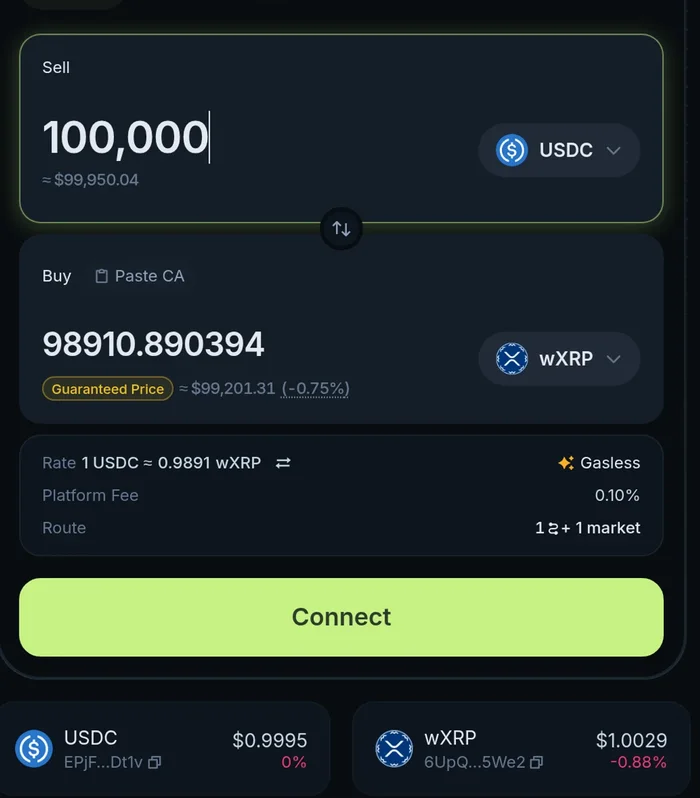
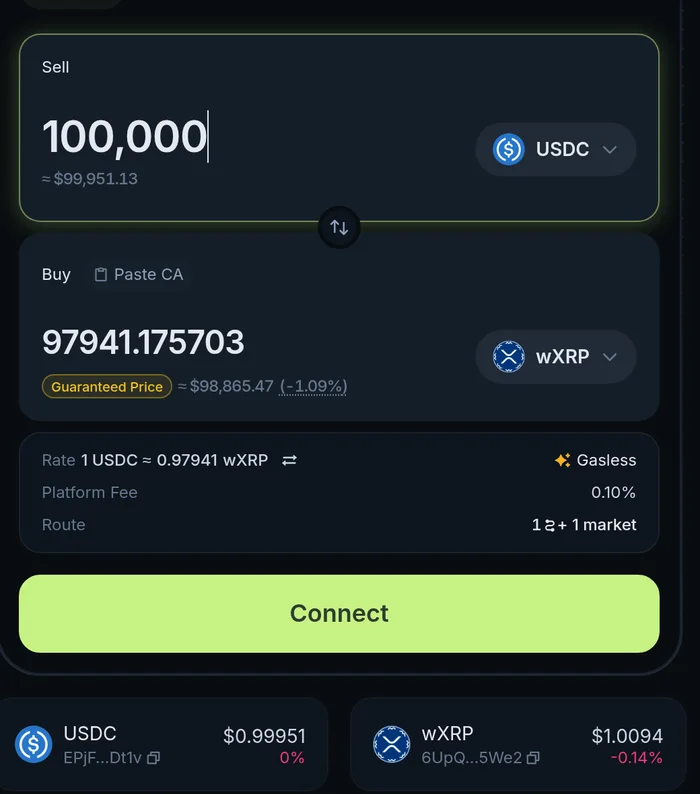
To be clear: Jupiter does fill $100,000 - 98,910.89 wXRP at the time of capture, badged "Guaranteed Price". But that price comes from JupiterZ, its market-maker RFQ system - liquidity quoted privately by market makers, stepping in precisely because Solana's on-chain markets cannot absorb the order. And it is a quote for a wrapped IOU - redeeming it for actual XRP goes through the custodian, not the chain.
On-chain vs on-chain, in Jupiter's own UI
You don't need an API to see this - Jupiter's own interface will show you. Its docs describe two swap modes: Ultra, "a complete execution engine" that blends its on-chain router with JupiterZ - "an RFQ system that enables market makers to provide competitive quotes" - and Manual, where you pick the routers yourself. Metis is the on-chain one: "direct access to Solana's on-chain liquidity via optimized routing" across all 103 of its AMM sources.
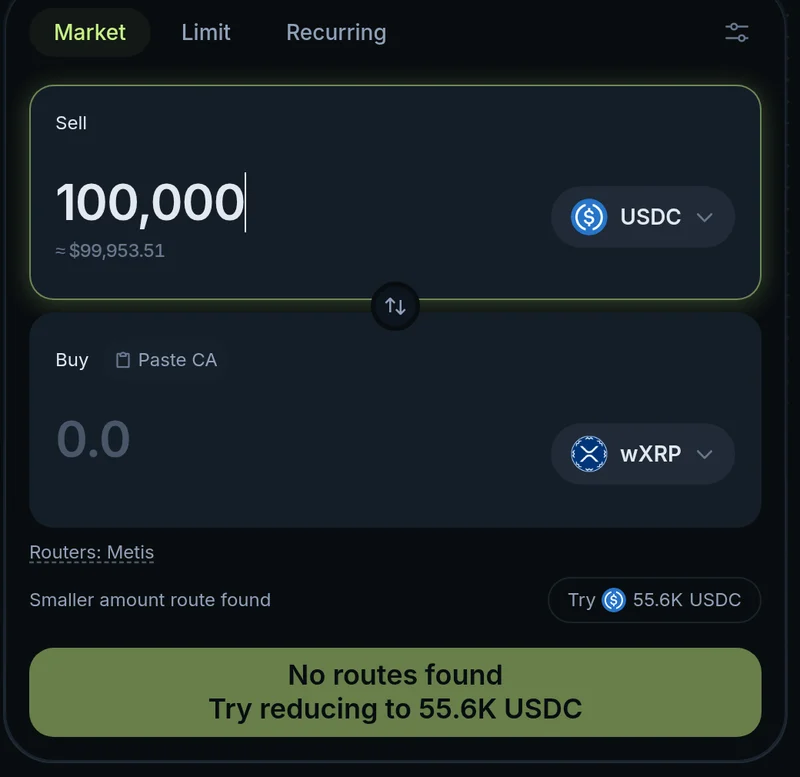
Set Manual mode to Metis only - Solana's on-chain liquidity, nothing else - and ask for the same $100,000: "No routes found. Try reducing to 55.6K USDC." Nearly half the order has to be cut before a route exists. Every $100k quote Jupiter does show is JupiterZ: a market maker pricing the trade privately. The swap still settles on Solana, but the liquidity behind it is not in Solana's pools.
Head to head
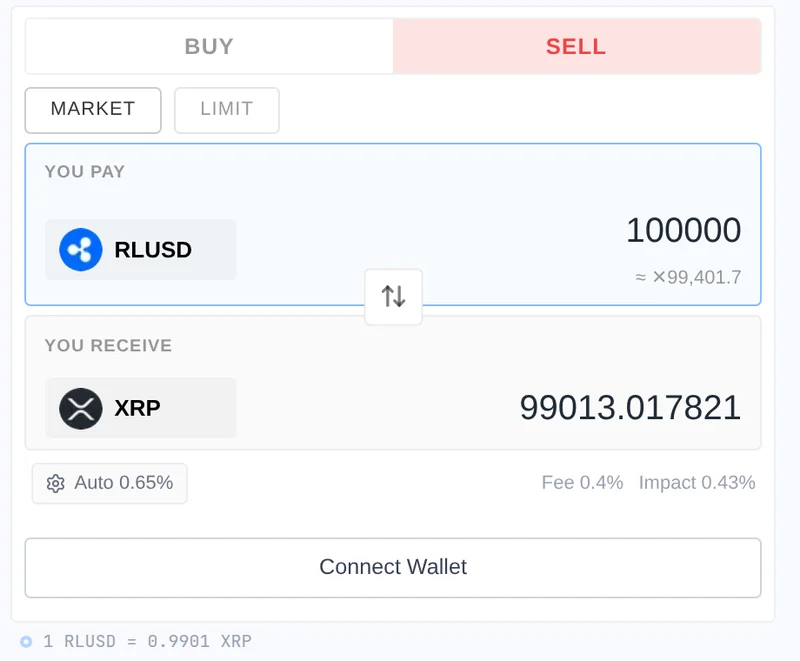
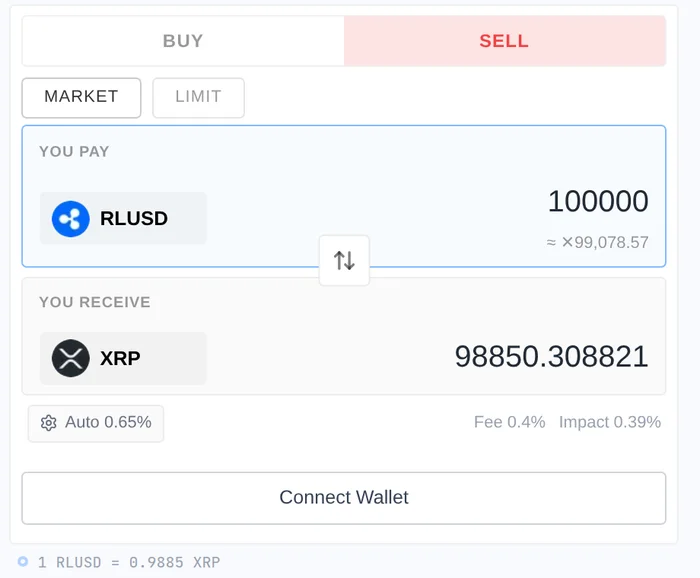
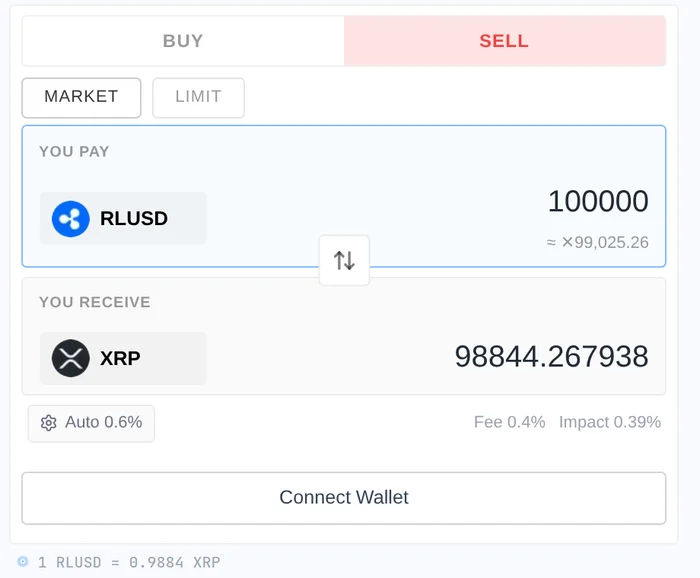
Side by side, same afternoon: Jupiter's market-maker quote for wrapped XRP against an open on-chain fill on the RLUSD token page. Selling 100,000 RLUSD returns 99,013.02 real XRP, fees included, at 0.43% total cost - no wrapper, no custodian, no market maker of last resort.
Same stablecoin, thin market: USDC on the XRPL
Two fair objections: the XRPL side sold RLUSD rather than USDC, and RLUSD/XRP is the XRPL's deepest pair - of course it fills. So here is the test with both removed. Circle issues USDC natively on the XRPL - the identical stablecoin from the identical issuer - and its XRP market is small: ~529k XRP of TVL, about the size of wXRP's entire on-chain footprint. A thin market against a thin market, selling the same dollar.
chain
| Trade size | Jupiter on-chain fill | Impact | xrpl.to USDC fill | Impact |
|---|---|---|---|---|
| $10k | 9,714 wXRP | 2.14% | 9,903 XRP | 0.36% |
| $25k | 23,546 wXRP | 5.11% | 24,758 XRP | 0.36% |
| $50k | 44,793 wXRP | 9.74% | 49,515 XRP | 0.36% |
| $100k | OFF-CHAIN98,911 wXRP* | - | 92,813 XRP | 7.08% |
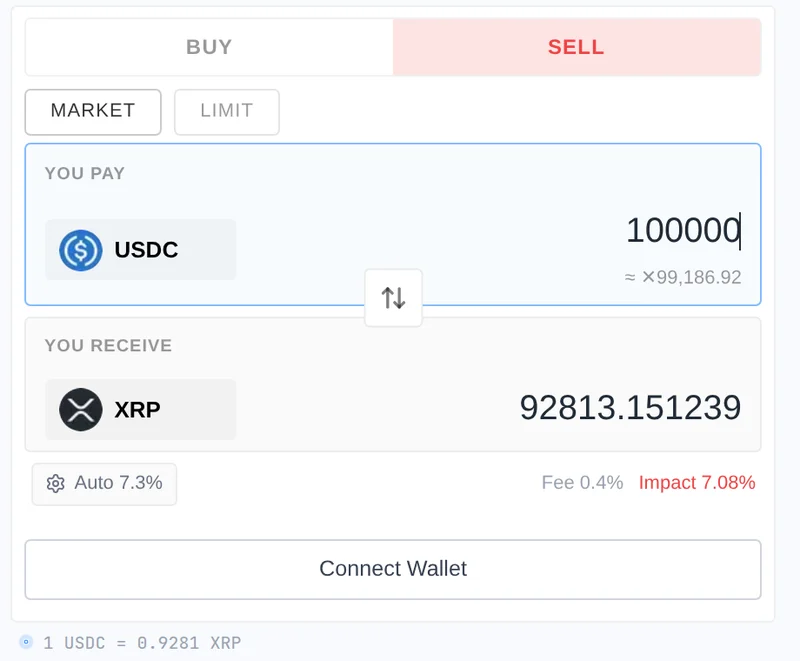
At $100,000 the thin market genuinely strains: 92,813 XRP out at 7.08% impact - printed in red by our own UI rather than hidden. That is what a thin market should do: degrade visibly, not vanish. Solana's answer at the same size is no route at all, and the AMM-only quote the viral post was built on would sit a further 44% below this fill.
Not a lucky screenshot
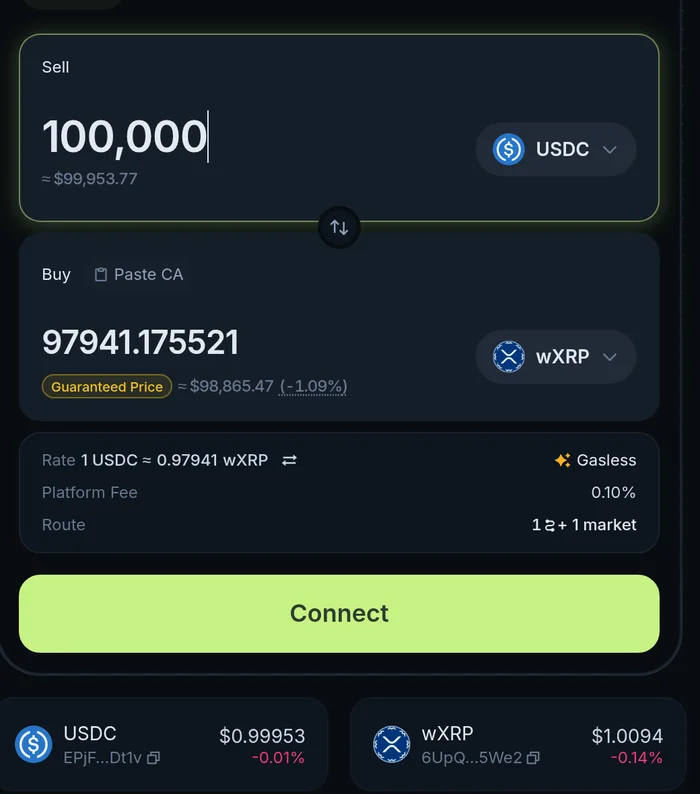
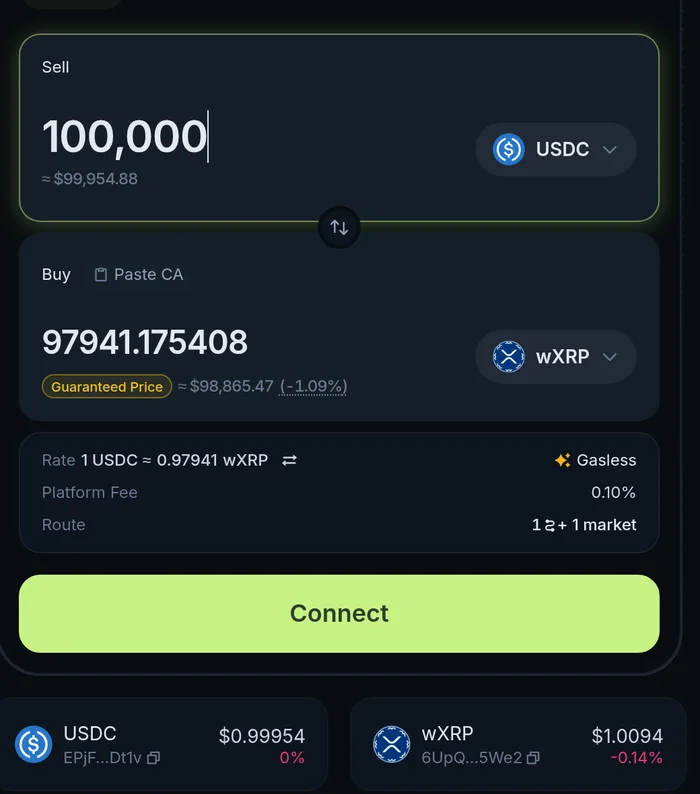
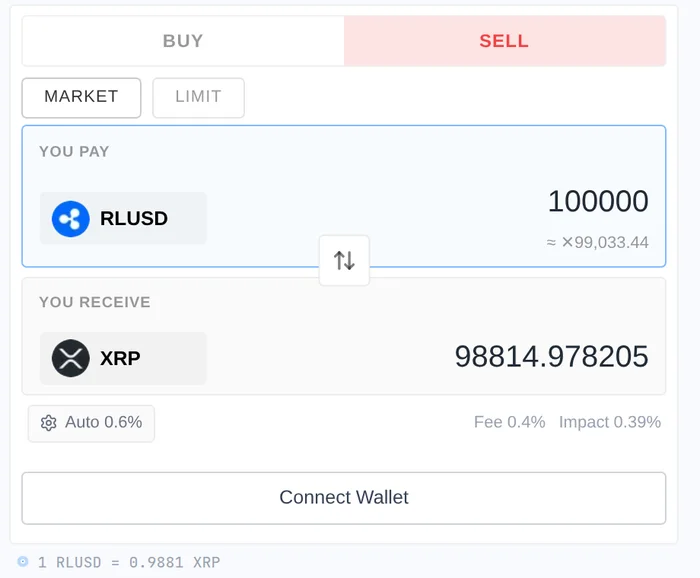
We loaded both venues in the same minute, three minutes running. Jupiter's quote read 97,941.18 wXRP all three times, identical to the fourth decimal - earlier in the afternoon it had sat at exactly 98,910.89 for forty minutes. A number that freezes for minutes at a stretch and then re-pins is a market maker's standing rate, not a market absorbing an eighth of the wXRP float. The XRPL side repriced continuously through the same three minutes - and delivered more XRP than Jupiter's simultaneous quote in every single pair.
Verdict
- What the post got right: an AMM-pool-only quote on the XRPL is a bad price - roughly 5% under the wider market at $100k. Compared against that one venue, a Solana screenshot can win.
- What it got wrong: that quote was never the XRPL's price. Measured market against market, the XRPL fills $100,000 on-chain at 0.19% impact, while on Solana the same order is priced off-chain by a market maker - and even that quote delivers less, in wrapped form, from a float smaller than ten such trades.
There is a structural reason the book carries the size. Stablecoin issuers and their market makers run their market making on the order book - quoting both sides all day, in size, to keep the peg tight. The 0.026% RLUSD/XRP spread with matched five-figure clips resting on each side of it is professional peg defense, not retail limit orders. A single AMM pool a couple of million deep per side was never where a hundred-thousand-dollar order should land whole - which is exactly why a comparison that only quotes the AMM misses the market.
The research points one way: for trading XRP, the XRP Ledger is simply the more efficient market - in its deepest pair and in its thin ones. Comparing chains through one venue's quote measures the venue, not the chain.
Method: captures 13 August 2026, 18:40-20:20 UTC. Solana: Jupiter's public quote API (on-chain routes) and the jup.ag UI (RFQ included); wXRP asset data from Jupiter's token API. XRPL: prices as displayed by xrpl.to on the RLUSD (Ripple) and USDC (Circle) markets, unconnected wallets, platform fees included in both UIs' figures. USDC and RLUSD both traded within 0.1% of $1. Related: Solana vs XRPL and How to swap XRPL tokens.